
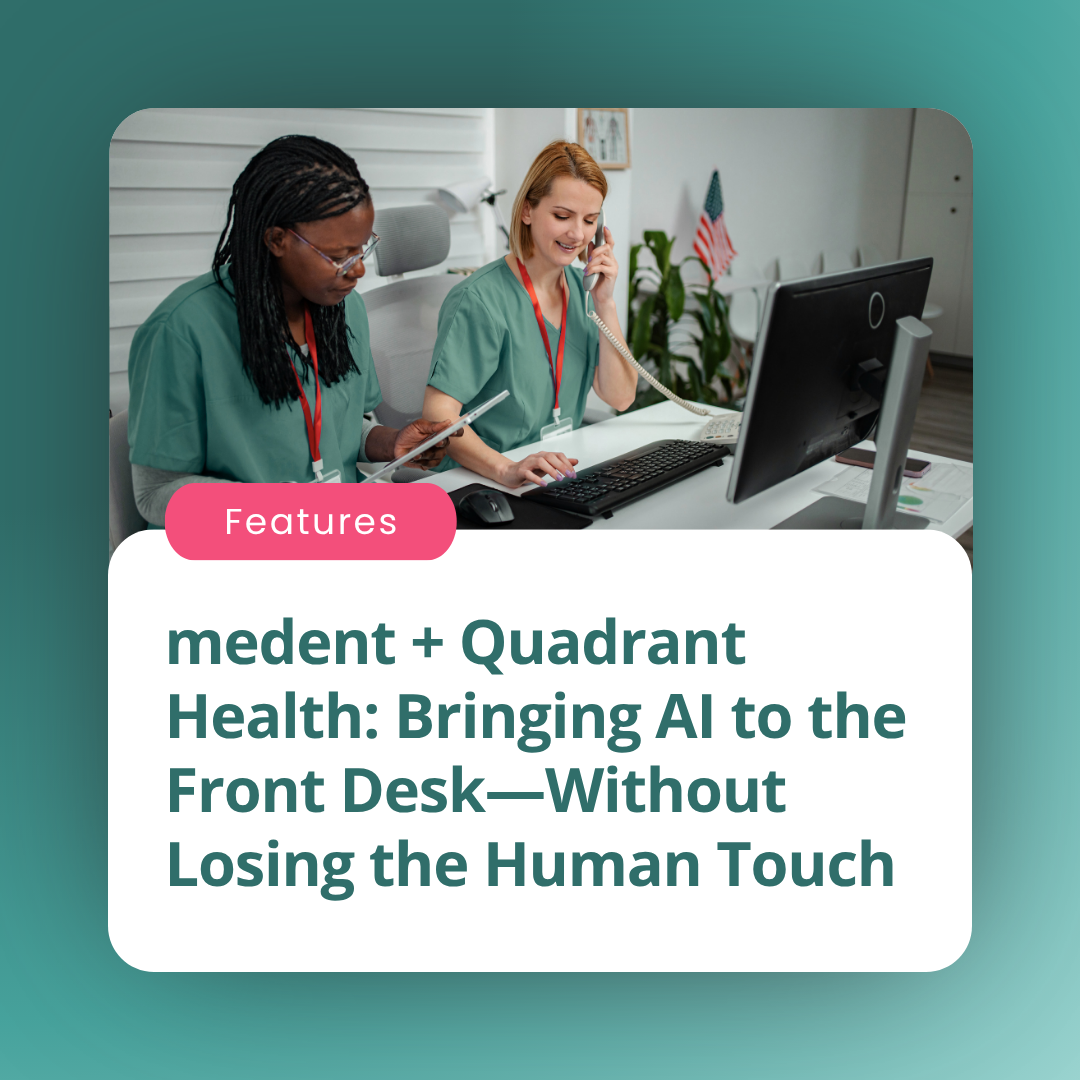

What if your front desk never missed a call?
It’s a bold idea, and for many practices, a necessary one.
With rising call volumes, staffing challenges, and increasing patient expectations, the traditional front desk is being pushed to its limits. That’s why medent has partnered with Quadrant Health to bring an AI-powered receptionist directly into your workflow.
But before you picture robotic voices and frustrating phone trees…this is something very different.
In Season 2, Episode 3 of medent minutes, we sit down with leaders from Quadrant Health to explore what an AI receptionist actually does—and what it doesn’t.
One of the biggest takeaways?
“The big picture here is that by automating this high volume of administrative tasks, we’re not only improving practice efficiency, but also freeing up staff so they can focus on delivering exceptional patient care,” said Krishna Gorrepati, Chief Technology Office at Quadrant Health.
This isn’t about replacing your staff—it’s about giving them breathing room.
If you’ve ever worked a Monday morning at a practice, you already know the pressure.
“Most clinics simply don’t have enough people to handle their peak days,” Gorrepati said. “So the team has to balance giving great service to the patient they’re currently talking to without sacrificing the experience for the patients sitting in the phone queue.”
Now multiply that by hundreds of calls a day and it’s easy to see why missed calls (and missed opportunities) happen.
Forget everything you think you know about automated phone systems.
“We’ve actually created an AI voice agent that sounds natural, understands the context and really carries on a real conversation,” said Hayes Milani, VP of Sales at Quadrant Health. “It’s a very different experience than what we’re used to.”
From scheduling appointments to capturing patient requests, this AI is designed to engage, not frustrate.
Right where they belong: at the center of care.
The AI agent doesn’t make clinical decisions. It doesn’t replace your team. It supports them.
“Alice is just like another employee…another member of your team,” said Sarah Riester, Project Manager at medent. “Calls that Alice takes are going to be created as triages in medent just like if a human staff member had taken the call.”
And the best part? It fits right into existing workflows. No overhaul required.
“Our goal with the AI receptionist is not to change what you’re currently doing,” Riester said. “The last thing we want to do is add more work to training your existing staff. So addressing anything that comes in from [Alice] works right into whatever current workflows you’re using.”
Curious how it all works in real practices? Tune in to learn:
How AI receptionists handle high call volumes
What patients actually experience on the phone
How practices can adopt AI without disrupting staff
Why this technology is gaining momentum now
Watch the full episode above or listen on Spotify.